
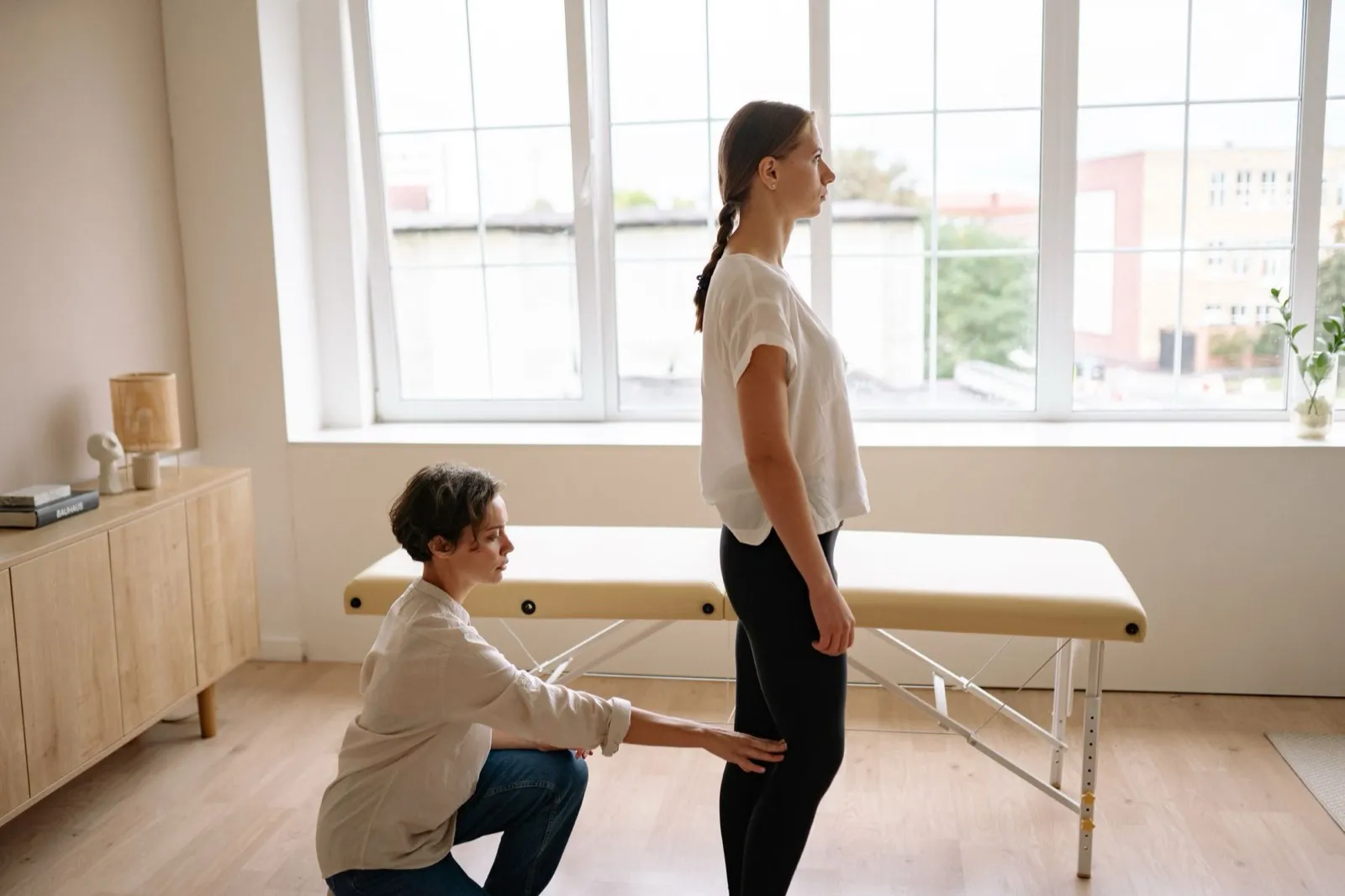
There is a category of post-partum symptom that a personal trainer should not be the first person you speak to about. Not because training is unhelpful, but because loading a system that is not working properly tends to confirm that it is not working properly.
This article is about how to tell which category you are in.
See a physiotherapist first if any of these apply
- Leaking urine when you cough, sneeze, laugh, jump or lift. Any amount, any frequency.
- Urgency, meaning you need to get to a toilet immediately, or you are planning your day around toilet locations.
- Heaviness, dragging or bulging low in the pelvis, particularly later in the day or after being on your feet.
- Pain with sex, at any point after you have been cleared to resume.
- Difficulty controlling wind or bowel movements.
- Ongoing pelvic, tailbone or pubic bone pain, including pain that started in pregnancy and has not resolved.
- A perineal tear or episiotomy that still feels tight, painful or different months later.
- A caesarean scar that feels tethered, pulls when you reach overhead, or is painful to touch.
If none of these apply and you feel broadly well, starting a well-designed strength programme after your six week clearance is reasonable. If any of them do apply, a physiotherapist first will save you months.
Why “just do kegels” is bad advice
Pelvic floor exercises get handed out as a universal answer, and for a lot of people they are the wrong one.
Two problems come up repeatedly.
Many people do them incorrectly. Research has consistently found that a substantial proportion of women given verbal instruction alone perform the contraction wrong, often by bearing down instead of lifting, or by clenching glutes and holding their breath. Doing the wrong thing more often does not help.
Some pelvic floors are already overactive. This is the one almost nobody hears about. A pelvic floor that is held tight and cannot fully relax produces many of the same symptoms as a weak one: urgency, pain, leaking, a sense of heaviness. Prescribing more squeezing to an overactive pelvic floor makes it worse, sometimes considerably.
You cannot tell which of these you are from an article, your own guesswork, or a trainer’s observation. An assessment tells you in one appointment.
What actually happens at the appointment
The unfamiliarity puts people off, so it is worth being plain about it.
A women’s health physiotherapist will take a detailed history covering your pregnancy, your birth, your symptoms and your goals. They will look at how you breathe, how you move and how you manage pressure. With your consent they will usually carry out an internal examination, which is the only reliable way to assess whether the muscles contract, relax, coordinate and hold.
You can decline any part of it. You can ask for a chaperone. It takes around an hour, and most people report it being far less uncomfortable than they expected.
You leave with a specific plan for your situation rather than a generic set of exercises, and usually with a clear idea of how long things should take.
Finding one in Singapore
Both routes work.
Public. KK Women’s and Children’s Hospital and Singapore General Hospital both have women’s health physiotherapy services. You will typically need a referral, from your obstetrician, a polyclinic or your GP, and the wait is longer, but subsidies apply.
Private. Singapore has a good number of physiotherapists with specific pelvic health training, including several within reach of the River Valley and Robertson Quay area. You can generally book directly without a referral, and you will be seen much sooner. Insurance sometimes covers it, so it is worth checking your policy before assuming it does not.
When choosing, ask directly whether they have post-graduate training in pelvic health and whether they perform internal assessments. Not every physiotherapist does, and general musculoskeletal physiotherapy is not the same thing.
Where training comes in
Physiotherapy and strength training are not alternatives, and they work best in sequence and then in parallel.
The physiotherapist establishes whether the system is working, treats it if it is not, and tells you what it can currently handle. Training then progressively loads it, which is what builds lasting capacity. Pelvic floor function does not exist in isolation from your hips, your breathing, your trunk or how much load you can manage. Strong glutes and a well-coordinated trunk do more for pelvic health over a year than any amount of isolated squeezing.
At the studio we work with this order deliberately. If a new client’s assessment turns up any of the symptoms at the top of this article, we say so and refer before we load anything meaningfully. It is not caution for its own sake. It is that training around an unaddressed pelvic floor problem wastes your money and your time.
One last thing
The phrase “it is normal after having a baby” gets applied to symptoms that are common but entirely treatable. Leaking when you sneeze is common. It is not something you have to accept for the next forty years, and the treatment is usually far less involved than people fear.
If you have been putting off asking about something because it felt too minor or too awkward, that is the thing to book about.